
By Vivika Vinod
Christmas, one of the most extravagant and famous holidays of the year. December 25th is a day filled with laughter, presents and love. But how did Christmas become Christmas? How did this festival come to be the celebration of the birth of Jesus Christ? How was Christmas celebrated in the past, and how has the past affected the present? These are the many questions that will gradually be answered as the article progresses. These questions are important, especially since one- third of the world’s population celebrates this famous holiday, and that is just the estimated amount, as a significant amount of atheists celebrate Christmas as well. The text below will provide information on the creation of Christmas and its impacts on the world.
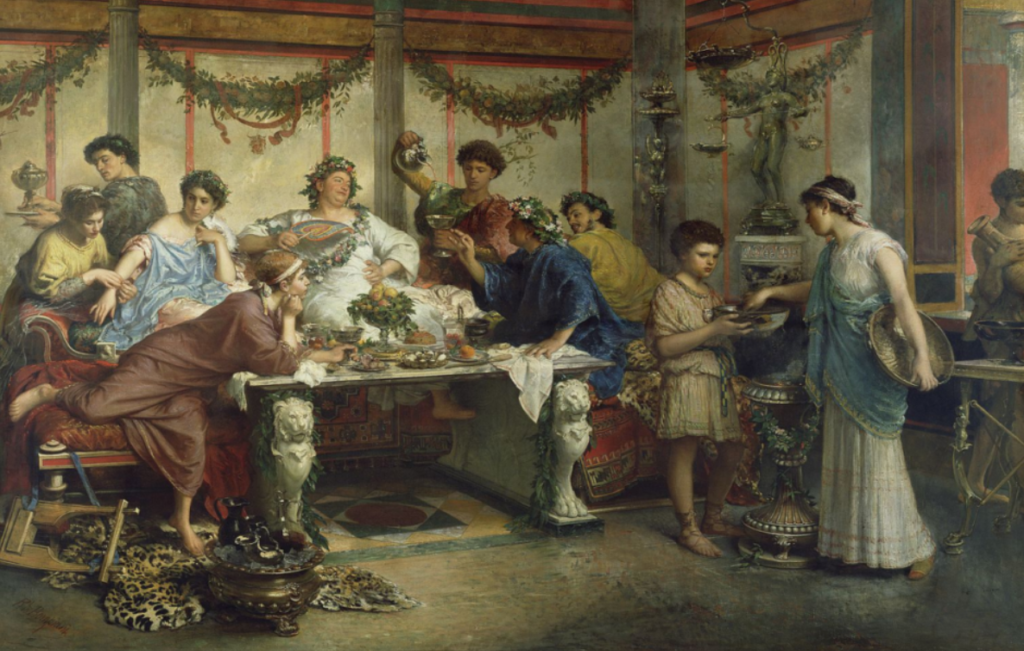
So, where did Christmas start? Christmas wasn’t originally a Christian holiday. It was a pagan festival celebrated by the Romans as the mark of the winter solstice. It was a holiday celebrating the birth of the Roman god, Saturn. Therefore, the name given to the festival was Saturnalia, a ten-day celebration with the 25th day known as Natalis Invicti (Watts, E.). The day was spent preparing feasts, giving presents, lighting candles and decorating the evergreens. Sound familiar? It is clear that Natalis Invicti and Christmas have significant similarities, and as Natalis Invicti existed long before Christmas did, it is safe to say that Christmas originated from Natalis Invicti. The question is how?
Around the time the pagans celebrated Saturnalia, which was approximately
1620 years ago (late 4th century AD), a new religion known as Christianity was formed (Watts, E). The church viewed the substantial size of the pagan population with growing apprehension. At the time, Christianity was still growing in popularity, with paganism being the primary religion for the Roman Empire. The church felt that it needed to do something to bring down the Pagan population and promote Christianity. So the church came up with a strategic plan. On December 25th, the day of the pagans’ beloved holiday, was to be the day on which the Christian god, Jesus Christ, was born. Nowhere is it specified in the Bible the birth date of Jesus. By placing the date of Christ’s birth on the same date as the pagans celebrated Saturnalia or Natalis Invicti, the holiday Natalis Invicti slowly faded away, as did Saturnalia. The Christians and the Church took all of the pagan traditions and used them for their own festival, which, in this day and age, is known as Christmas.
With the gradual disappearance of Saturnalia and Natalis Invicti, Christmas became the most prominent winter holiday, along with the Jewish holiday Hanukkah; however, the latter has no significant relevance to the destruction and disappearance of the festival Natalis Invicti. Over time, the pagans were gradually converted by missionaries and members of the church. The conversion was through false claims like Christianity having the same practices as the pagans and convincing them to convert to a “better” version of their own religion. Another conversion tactic was fear by convincing people that not following Christianity would result in an incredibly negative life filled with disruption and disarray. The third and most efficient form of conversion was force. Many Christians forced the pagans to convert with a threat to their lives and those of their loved ones. This was the most successful tactic used, not just in this instance but throughout history and resulted in the near abolishment of the pagan religion.
In conclusion, the history of Christmas and the transformation of its roots is significantly more complicated than many know. The pagan population in the world today is under 1%, with around a few million scattered around the world, with the biggest population being in the United States, with around 1.5 million people (Teach Democracy). Natalis Invicti is a festival that technically still remains today as one of the world’s largest and most popular cultural events; people simply use another name for it. Although the information on the development of Christmas is not very well known and the name Natalis Invicti is rarely heard of, the culture of the festival has survived hundreds of years with changes both positive and negative. The key thing to be recognised is how traditions have survived through change in religion and rapid modernisation. May the Natilis Invicti live on for many more generations to come.
The poem/ prayer below was said on the second day of Saturnalia and is one of the few prayers still practised by Pagans today. It is known as Saturn’s release, an ode to the god of agriculture, abundance and wealth; Saturn.
Below is the prayer
Calendar of the Sun
18 Yulmonath
Saturnalia Day 2: Saturn’s Release
Colors: Black and Gold
Element: Earth
Altar: Upon cloth of black place eight gold candles, each surrounded by gold coins, a bottle of good wine and many cups, and the figure of a seated man, wrapped in a chain.
Offerings: Throw over routines and take joy.
Daily Meal: Anything that the folk of the House want, correct or otherwise.
Invocation of Saturn’s Release
Hail to the Lord of Discipline,
Saturn is bound in chains.
Hail to the Old Man of Time
With your fearsome sickle,
Lord of the Hourglass, the Sundial,
All that places restrictions on the bright,
The beautiful, the free and easy.
You live an existence bound in chains,
But at this time of the year, dark and cold,
We release you from your bonds!
We acknowledge that order cannot be held
Without respecting that which is chaos,
And so we pay for the blessed order of our lives,
The gift of Saturn, and Eunomia, and many others,
By these days of release from that Order.
We release you, O Lord of Limitations,
And pray that you, and we, shall be glad
Once more to place these chains about you
And about ourselves. Hail Saturn!