
By Mali Martel Simonetti
Introduction
New Year’s are universally recognised as fresh starts, an empty calendar, or rather canvas waiting to be painted with uncharted ambitions, emerging responsibilities and ultimately, novel difficulties. It’s a strange yet greatly assimilated notion. One could have endured a harrowing year of persistent struggles, but as the clock strikes midnight on the 31st, for many, it’s as if all is renewed, and they’ve been granted a new chapter in their life’s stories. Nevertheless, from the student perspective, nothing embodies renewal quite like the start of the school year. In this context, however, it isn’t always an indomitably optimistic clean slate, but rather a double-edged sword. It presents a paradox: the daunting incongruity of potential and pressure. Secondary school, while arguably a short yet distinct juncture of the human life, is marked by a pivotal stage in all the intimidating cognitive development, otherwise known as maturing from considering crayons as an afternoon snack to conquering the intricate web of social and academic responsibilities. It also makes the difference between an existential crisis and a criterion A math summative seem insignificantly small. No, it’s not insanity; in fact, it is a psychological phenomenon coined the “Reminiscence Bump”, where adults over 40 (rest assured, it’s not for a long while) recall their adolescence and early adulthood more prominently compared to other periods in their lives.
Regardless, no matter the science or rational explanations justifying it, it doesn’t resolve the lingering fact that these years ahead will feel intense and memorable, although experiences will be processed differently by all. But these emotions and ordeals aren’t new to the human race, and for centuries, they have conceived infinitely many forms of self-expression. Compositions and artworks that will remain preserved in time, the moments they felt they would never escape, frozen in time. For what reason? To resonate with an audience. An audience who can gaze into their work and see a reflection of their own thoughts and feelings, and whether intentionally or not, gives rise to a new generation of visual narratives as a means of emotional regulation in times of overwhelming transitions. It’s the concept of using art as an emotional mirror, for the language of visual expression and sentiment is everlasting.
The Scream
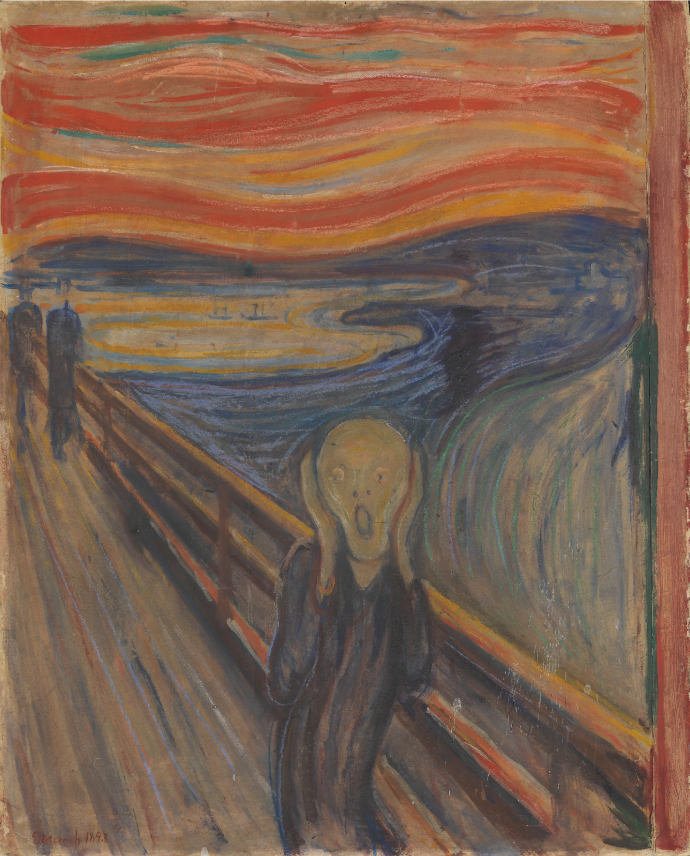
Edvard Munch’s The Scream is arguably one of the most globally recognised works of art out there. For those interested in its history (a context that’s valuable regardless), it is an expressionist piece, a style characterised by the use of distorted forms, intense colours and symbolic representation to depict emotional and personal experiences. Beyond expressionism, Munch’s composition communicates a psychological state that is often defined as a “Soul painting” in which abstraction is utilised to capture an artist’s inner essence and, in most cases, turmoil. There was a total of 4 variations, the first and second having been created in 1893, and in successive years, his third in 1895, before the final rendition in 1910. Munch’s creative impulses and connection to the powerful motif he depicts in the work prompted him to experiment and recreate the piece with a variety of media. It is presumed he kept one of his versions due to his personal reflection and relationship with the themes he explored on the canvas. Few pieces have succeeded in illustrating the universally relatable human experience of unease and anxiety, yet Munch was already ten steps ahead, not only portraying his own existential dread but also allowing audiences to project their own experiences and relate, no matter the context. The anonymity of the skull-like figure opens infinite doorways of subjectivity and audience interpretation, enabling individuals to process the painting through their own lenses. Munch’s distorted figures perfectly convey the turbulence and apprehension that come with entering a new chapter. It encapsulates the true nature of our academic and social worries and their unpredictability. No different to Munch’s inspiring experience, the gnawing agitation of restless school days and approaching assessments mirrors the swirling tension and uncertainty he captures in his work. His externalisation of his intense emotional distress through twisted abstract forms and colours created reflections that all can recognise and perhaps take inspiration from to find ways to channel their own turmoils rather than letting them consume them, perhaps even becoming a world-renowned artist in the process.
Nighthawks
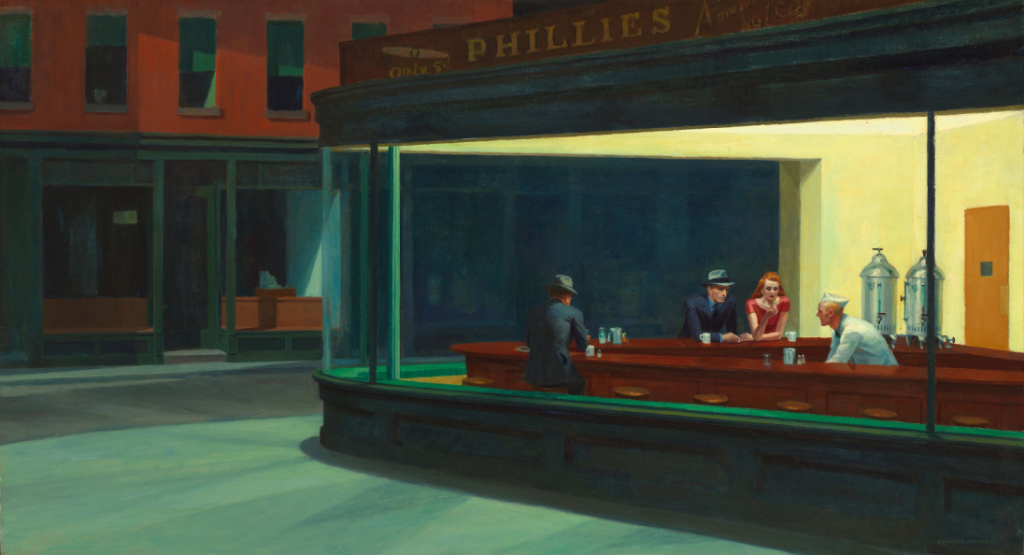
The American Realist and Modernist, Edward Hopper’s Nighthawks, beautifully represents urban isolation, as it depicts four people seated in a diner, physically close but utterly disconnected, all alone in a room with company. In a historical context, their profound solitude and alienation from one another reflect the period in which the work was painted, 1942, during the Second World War, mere weeks after the bombing of Pearl Harbour and the U.S’s entry into the global warfare. His piece is also discussed to fall under the social realism movement, where realistic styles were used to critique social conditions. The isolation, fear and uncertainty of the time are prominently represented in the piece through its purposeful organisation of light and shadow, also creating a visually and psychologically captivating contrast between the cold exterior and the diner’s artificial light. This work, in particular, is very paradoxical in nature. Think of it this way, diners and restaurants are conventional locations designed for socialisation, yet the people inside remain secluded. The seemingly connected space is only filled with an unavoidable profound solitude. As the piece includes an open-ended narrative, it certainly inspires self-reflection, and it’s a fair assumption to say that nearly everyone has felt a sense of estrangement before, or even just an inexplicable loneliness, even when surrounded by an entire crowd. It’s that sense of voyeurism that Hopper has frozen in time through his work. And that same feeling of being on the outside of an unfolding scene is not unfamiliar to many, especially in school environments. With so much going on at once, it can feel as though one is suspended in time; however, similar to how the diner symbolises a beacon of warmth, certain things can help close the gap between cold, distant realities and personal sanctuaries, so to speak. Whether it’s a favourite teacher’s room, the library or that collectively agreed-upon lunch spot everyone seems to subconsciously retreat to, there is something about seeing personal narratives resonating externally with someone else’s visual expression that’s incredibly evocative and, to go to the extreme, perspective-altering. In the sense that personal experiences, loneliness, anticipation and uncertainty are reflected and validated through the human chronicle, giving depth and context to emotions that otherwise remain unseen.
Wanderer above the Sea of Fog
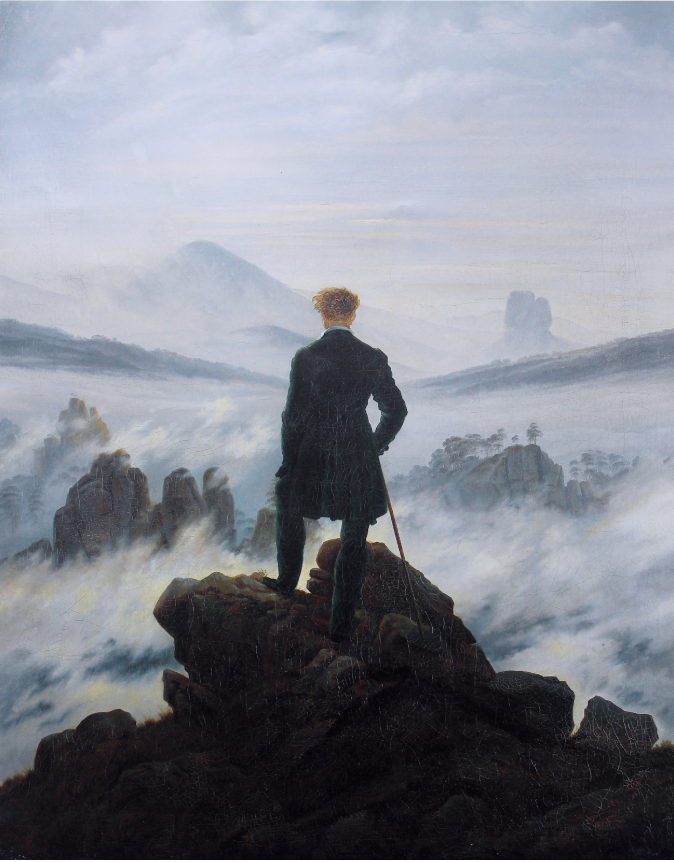
The masterful balance of imaginative, sublime and symbolic landscapes is entrancingly applied by German Romantic painter Caspar David Friedrich to illustrate the human encounter with sublime natural forms and make meaningful connections between nature and the inner self. The Wanderer above the Sea of Fog is one of his most famous works, and made him a key figure in the Romantic movement between 1800 and 1850, during which he painted the famous composition, considered a masterpiece within the context of the rising art style in 1818. German Romanticism’s emphasis on emotion, imagination and individualism as well as fascination with nature and the supernatural, allowed his piece to resonate with audiences on multiple levels, intricately layered on top of each other to create a depth in the painting both through artistic techniques and Friedrich’s personal expression in vast themes such as the individual’s emotional response to the unknown, and the mystery of purpose within the grandeur of the unvisere. The fact that the man is not facing the audience creates a Rückenfigur effect (where a figure is facing away from the viewer), inviting viewers to share his perspective, a recurring element within the previous paintings, is yet again seen here, and once again, an important motif that is what makes it an emotionally evocative and identifiable amongst billions of artworks worldwide. The Rückenfigur’s bigger picture embodies the tension between opportunity and uncertainty as students begin to look towards the future of their school year, inciting contemplation of their place within the universe on a grand scale and the vast expanse of experience, knowledge and process they have yet to explore, still teetering on the threshold of unknown outcomes as the first semester begins to pick up the pace.
Eras and chapters close, history unfolds, and moments pass, whether a school year or a lifetime; they all eventually reach their conclusion, and yet the feelings they evoke endure generations of change and evolution, captured and revisited again and again through creative expression. Transitions are inevitable and bring both challenges and opportunities. Still, it can be initially difficult to differentiate them, and far too easy to get caught up in the timeless whirlwind of raw and unprocessed emotions often withheld. While it may sound like an inapplicable method of approaching the new year, observing and internalising meaningful artistic concepts and works can deeply aid in making sense of these sentiments. It not only provides perspective, allowing interpretation and regulation by seeing them in a visual representation and narrative form, but also externalises feelings that can’t be said with words. The mere tangibility of it encourages reflection, enabling one to physically step back and make sense of internal experiences, while understanding the universality of the emotions and how they’re part of a bigger picture, reducing isolation. School will never really change; it’s a constant and a necessary stage in the human life, so in order to move forward and create constructive change, it’s one’s approach to the year that forges the path. The year itself doesn’t change; the fresh calendar and the reset clock don’t make a difference, and neither do new routines or empty promises. What matters is how each day is individually handled, and how each moment shapes the experience of the year as a whole. This is where an artistic lens offers its relevance, serving as a reminder that reflection, perspective and creativity are able to turn routine into something more and the year to feel worked through rather than simply endured. For a reflective lens shows that a year isn’t only lived, but interpreted.