
By Anna Ren
Managing expectations has become unprecedentedly difficult for us in the era of flourishing media, with all the plethora of colorful visual stimulations originating from all corners of the world, ultimately ending on our tiny screens. These online platforms create gaps that are difficult to overcome through individual efforts too early; behind the lens of content creators, there is the overarching accumulation of great efforts that many underestimate. We gradually become comfortable with comparing ourselves and admiring others unconsciously, and in the same state of mind, set ridiculously high expectations.
First, we all begin to realize that what truly determines the level of happiness in life is not secular gains, achievements, or glory, but the hole residing in our inner sense of satisfaction, contentment, and self-consistency.
We always uphold high expectations for ourselves, whether that is inherited from the academically intensive environment or extreme parental expectations. Setting a high target can be a good way to challenge oneself, but the problem lies in placing expectations beyond one’s actual abilities, which can lead to forms and signs of depression, such as stress, frustration, and disappointment.
In an interesting research on Olympic gold medalists, it is said that being the first-place finisher has the greatest satisfaction. Gold feels the best, no surprise there. There’s really no reason to be disappointed about gold unless you’re Yoshikage Kira. The twist is that the study reveals bronze medalists express greater happiness and a stronger sense of achievement than the silver medalists.
The reason sounds counterintuitive but is true: the silver medalists compare to those that placed higher, as they are what “they could have been”, while the bronze medalists see the bigger picture and are just happy to “make it into the podium”. This dichotomy highlights how expectations can lower one’s satisfaction and sense of accomplishment, even if you’re ahead of others.
On the other hand, if we avoid being over-frustrated and competitive, which lowers expectation in long-term habits, it can also limit one’s potential and confidence.
Another famous experiment that reveals the potential of expectation is Dr.Robert Rosenthal’s “Maze Bright” and “Maze Dull” rats experiment. It was a study on the ‘Experimenter’s Expectancy’ effect, demonstrating that the unconscious expectations of researchers can indeed influence the performance of their subjects. He randomly selected two groups of rats, and his students were asked to train them to navigate a maze. However, students were told that half of the rats are “maze bright” and half of them are “maze dull”. As a result, students reveal that the rats labeled “maze bright” actually provided better results in their ability to run faster, be more stable, and navigate more accurately than the “maze dull” group. Ironically, there is no genetic difference within the two groups; all rats are standard lab rats.
So really the students were the dull ones.
Analyses made after the experiment claim the disparity between the maze-running results is due to the student’s subconscious expectations which led them to treat the rats differently. For instance, students were shown to be more likely to treat the “clever” groups gently and give them more attention, and they may unconsciously offer more encouragement. Steve would’ve also taken these rats to an onsen as part of their vacation, so that was rather unprofessional of them. These minuscule changes contributed to building more confidence and lowering the anxiety for the rats.
This lab report demonstrated the power of expectation, even the subconscious insights can significantly influence one’s outcome and behavior. The two examples reveal a simple yet hidden truth: We are indeed subtly influenced by both internal and external factors, thereby achieving the self-fulfillment we envision.
But now you’re scratching your head for more: With a thorough understanding of the power of expectation, how can you manage it effectively?
From a young age, I was inundated by voices that taught me how to run faster, jump further, and fly higher. Around us, the slogans like “if you don’t work hard, someone else will surpass you” constantly echoes. More importantly, the tense academic environment is stressing me out to the point it almost consumed me. Imagine you are surrounded by a group of highly intelligent people, whose hobbies are probably correcting ChatGPT on a daily basis, every action they take adds dumbbells to your shoulders. From them, I learn to compromise, settle myself down and endure the pressure.
As a grade 10 student, on the brink of taking DP courses, managing expectations seems to be more unprecedentedly important than ever as it determines the effectiveness of learning, something that has gained more relevance than it already did. Here, I will share some personal tips that effectively help me balance my goals and expectations.
- Ground your vision in reality: This helps you identify what you want to achieve personally. When you imagine your older vision, you will unconsciously re-evaluate yourself, subconsciously build values within yourself, and therefore be willing to delay gratification in order to see the version of yourself you aspire to become. If the sense of realism is weak, you’ll reconsider your capability for this goal.
- Specific your goals using The Eisenhower Matrix. It helps you prioritize your most important and urgent task.
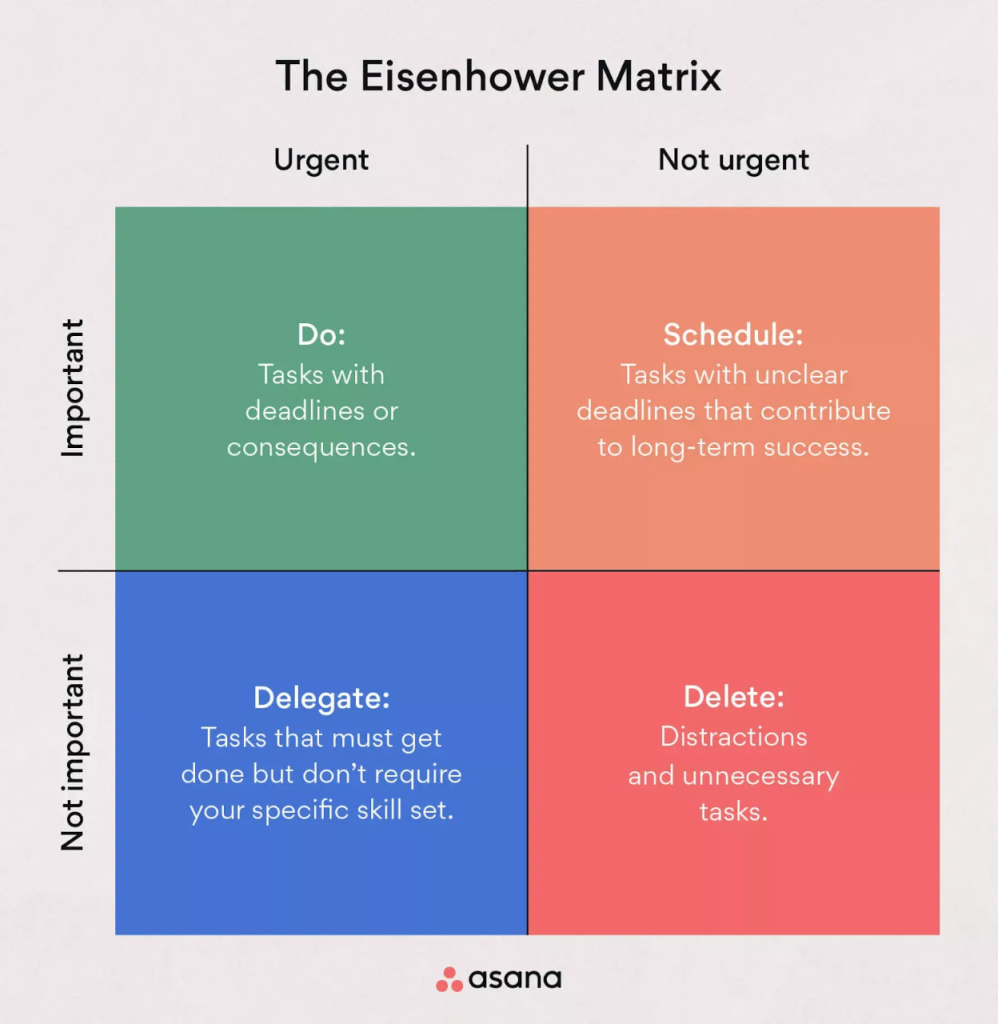
Instead of writing a to-do list, separate them by quadrants. Once you take a good look at your tasks in their designated categories, you’ll be able to complete your most important work first.
Whether it’s in study, business or daily routine, everything seems to be on fire (in the most metaphorically literal way possible), which will cause emotional and even physical burdens to yourself. List all your target goals and specifying them is a very beneficial way to help you get rid of anxiety. There are many ways to effectively control expectations, but each suits a specific type of person and style. In fact, what really matters is not the solution we hold, but your heart, and knowing what you value the most.
Ultimately, you will notice that not everything deserves your attention and time, but hopefully this was not one of those things.