
By Mali Martel Simonetti
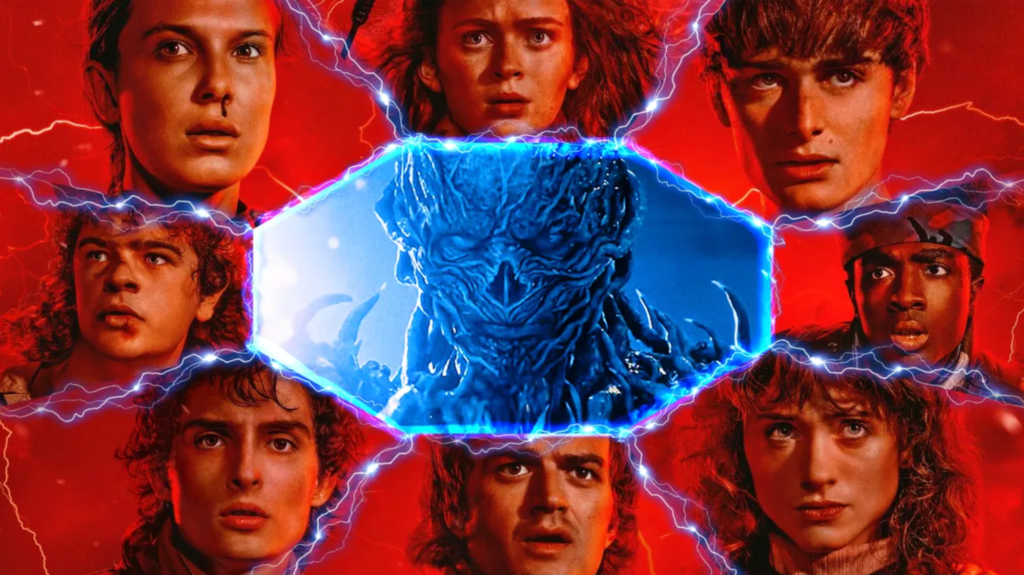
10 years of production, 42 episodes, over 50 credited performers, and a budget of $480 million on season five alone. Stranger Things has certainly evolved. From its beginnings as a dubious proposition, rejected countless times by numerous networks, to shaping a devoted fan base driven by their appetence for nostalgia and the innovative spin the show takes from conventional storytelling. The Duffer Brothers were able to span the multigenerational divide with the program’s meticulous recreation of the 1980s, depicting the era’s aesthetics, music, fashion and making artful allusions to the pop culture at the time. The masterful execution of the worldbuilding established an immersive escape for older audiences and a fresh take on entertainment for the youth who hadn’t experienced that epoch. The show’s nostalgic feel, paired with the character-driven narration, carved its spot in the hall of fame as a massive global phenomenon that proved that every venture is worth pursuing. However, despite its praise throughout the years, the show’s fifth and concluding season has received substantial backlash and criticism from fans all over the world. Now, could this be their way of coping with the loss of a series that has taken them on an exhilarating journey of storytelling, or perhaps even shaped their childhood? Or are they right in saying that the Duffer Brothers may not have stuck the landing this time around?
Remembering Stranger Things’ Roots
Stranger Things has undeniably brought forth a lot of room for discussion and debate throughout the entirety of the production of its 5 unforgettable seasons. Its long-running nature, the fire that was fed with each new episode and the greatly anticipated wait for a finale put the directors in a difficult position to please every viewer. Nevertheless, as the show grew in popularity and its fantastical world expanded with the imagination of every new admirer, fans began to forget the roots of the Duffer Brothers’ pioneering storyline. This show arose from modest beginnings, two aspiring siblings with the hope of bringing their vision to life. Season one, while still impressive, with its special effects and cinematography, was nothing revolutionary at the time. What really made the show stand out was its depiction of childhood adventure in its rich blend of 1980s nostalgia, supernatural horror, and sci-fi mystery and its primary themes of friendship, bravery and most importantly, coming-of-age. Stranger Things famously made homages to beloved movies, books, and series of the era it was captivated by. Many describe the series as a “love letter to the 80s”, reinstating the outstanding message that connection and courage always prevail in the face of adversity, through its inspirations from classics written by Stephen Spielberg, Stephen King and John Carpenter. The contrast between the cold, dark threats that lie beneath in hidden dimensions and the warmth of human bonds, identity, love, loss and growing up. The show is and forever will be a cinematic mixtape of childhood experiences and struggles with a touch of the psychological thriller everyone has come to know and love.
Acknowledging Season 5’s Fulfilling Role In the Story
Season five began with a non-objective disadvantage. It was never seen as an equal to the preceding seasons, but instead was constantly compared and contrasted with the ideals of how the season should play out. The knowledge that it was the final season of the show set an unattainable bar of expectation for the show to meet. The fans’ emotional bias and the grief of parting with the show made them unable to see the season as it is, but only as they wish it could be. Therefore, in honour of the show’s last stand, it’s only fair to acknowledge the questions that were diligently answered, the character’s individual growth and the bonds that were broken and reconciled throughout the season. Not to mention the impressive evolution of the visual effects, props, sets and cinematography as the show reached the peak of its supernatural essence. For the sake of brevity, the list will include only the highlights, although the small details and references are equally clever:
- As in most of the seasons with characters such as Bob (S2) and Eddie (S4), a new supporting character was introduced. Derek Turnbow. Otherwise referred to as Delightful Derek. His strong personality and humorous depiction of the “classic” middle school bully threw him into the spotlight within his second appearance on screen. His character arc, besides being one of the most entertaining, took on the role of crucial comic relief, particularly since the main sources in the series, Dustin and Steve, were occupied with navigating their strained friendship. Derek even offered a surprising depth through his evolution from a stereotypical bully into an unlikely hero, perfectly embodying the show’s theme of finding greatness in uniqueness.
- The Upside Down, being a wormhole, the bridge between two worlds, was an ingenious concept. Although it had been part of their plan for the show years ago, the reveal in the latest season was perfectly executed, a nerve-racking amount of suspense paired with familiar and (half) feasible scientific theories. However, beyond its direct influence on the visual elements of the show, the decision allowed the directors to extend the story beyond the well-known dimension, The Upside Down. It offered the storyline an opportunity to rewrite itself, so to speak, changing the rules of the game for each of the characters and the audience. Aside from assisting the series in avoiding ‘Upside Down fatigue’, it cleared a path for a clear narrative closure. The wormhole theory allowed for a definitive ending to the threat the dimension poses by collapsing the bridge, providing a suitable conclusion to the series’ central conflict.
- A smaller detail in the grand scheme of things is the inclusion of Mr Clark, and how he was finally involved, even visiting The Upside Down himself. Without Google or the internet, characters in the show often resorted to their beloved science teacher for answers, making him an unsung hero of the entire show. Seeing him enter the world of the supernatural phenomenon, the others, who are so well versed in it, made for a satisfying closure to their relationship and a loveable “the student becomes the master” moment.
- Dustin and Steve’s lengthy dispute put everyone on the edge of their seats. It’s a rough watch when two of the most loved characters go through an essential period of relationship development, but it really was absolutely necessary. Their strained relationship, whether people realise it or not, began as soon as Eddie Munson came into the picture. While a brilliant character, he drove a wedge between Dustin and Steve, with the help of their quickly-made assumptions. Steve felt replaced, and Dustin found a sense of belonging in Eddie without realising he was distancing himself from his best friend at the same time. Their fight forced Dustin to confront his deep grief over Eddie’s death, revealing his hidden pain and fear of losing Steve, leading to a cathartic breakdown and a powerful reconciliation. In the end, it solidified their bond as they vowed to face the final battle together, making it a significant turning point for their friendship.
- Eleven’s “death”, or rather her separation from the group, faced heavy criticism, with fans stating it wasn’t the ending they deserved. However, her disappearance actually served a greater purpose and was necessary for several key narrative closures. Her sacrifice, whether real or an illusion, ended the cycle of government experimentation on innocent mothers and children. While Mike chose to believe they could have hidden or run away from them, Eleven knew that her choice to prevent others from experiencing the same trauma as she did was the first step in taking control of her own destiny, something she couldn’t have done while constantly worrying about being tracked down or having her friends and family hurt as leverage. Without the ambiguity of her fate, her friends, particularly Mike, wouldn’t have been able to move past what happened. In many ways, it symbolises the characters’ transition from childhood to adulthood, where Eleven represented the “magic of childhood”. For each of them to fully grow up and move on from the supernatural threats that defined their youth, that same “magic” had to leave Hawkins. The narrative choice also emphasised hope and the power of their belief, keeping the series true to its roots by processing the trauma and loss by believing in something better, rather than facing a definitive, tragic death.
- Will’s character was always a passive victim, the “weak” boy who was used and dismissed, which is why his character arc in season five was crucial to the story. His powers and strengthened ability to tap into the hive mind are a grand payoff for years of Will being haunted and isolated; his deep connection to the Upside Down, once a source of fear, becomes the very thing that turns him into an active participant, changing the fight and making his personal story integral to the plot. The thematic depth of his evolution always comes back to his identity; it mirrors the struggle of being a queer kid in the 80s, finding strength in himself amidst intense fear and homophobia, giving his internal battles a supernatural weight and allowing Will to finally mature emotionally.
- Whether or not everyone fondly remembered Eddie’s speech to the members of the Hellfire Club, in which he described his rebellious plan for his graduation day, Dustin’s valedictorian speech was as heartfelt as it was entertaining. However, the reference made it all the more meaningful. In season four, Eddie said, “I’m gonna walk that stage next month, I’m gonna look Principal Higgins dead in the eye, I’m gonna flip him the bird, I’m gonna snatch that diploma, and I’m gonna run like hell”, and funnily enough, that’s exactly what Dustin did. It was a beautiful moment and certainly a unique way to incorporate the show’s youthful essence into a moment which is universally thought to be when one grows up. After years of feeling like an outsider, Dustin and his friends found solace in Eddie’s acceptance, playing a pivotal role in Dustin’s development, so the homage feels well deserved and a fitting way for Dustin to pay his respects to Eddie one last time as he prepares for the future.
- No matter how heavily debated the entirety of the final season is, the nostalgic closing scene was a brilliant finale. The identical beginning and end of the show certainly had fans emotional, a full circle moment that brought the characters back to the Wheelers’ basement for one last Dungeons and Dragons game, and powerfully symbolised their having to say goodbye to their childhoods. Not only did this honour the show’s origins, but it also provided hopeful closure for the characters moving forward into new chapters of their lives.
Fan Theories: The Antagonists Behind the Scenes
For the longest time, fans have preoccupied themselves with developing their own versions of the story’s continuation. Many take morbid paths, others opt for Marvel-style action and explosions, while others desire heart-shattering drama. Some even, in a desperate effort to console themselves, fabricate the perfect happily ever after we all know is likely improbable. In their attempt to chase the best conclusion or even just a sense of fulfilment in having guessed correctly, most stray from the roots of the series and everything it slowly built up to. Every theory wove the plot into an unnecessarily complex knot, grasping at connections and “easter eggs” that may not have been relevant to the storyline. They completely shift their focus from experiencing what the story has to offer to trying to ‘solve it’, often overshadowing character development and the Duffer Brothers’ original vision, turning the show into a game of prediction rather than enjoyment, distracting them from the artful creation of the show. A large part of season five’s backlash can be traced back to a warped vision of the show’s narrative. Many fans’ intense speculation pressured creators and made millions of other fans resistant to the final authorial decisions for not following the “headcannon” they fixated on. Some of these theories included Vecna being Henry’s evil alter ego, which disappointed many fans as they expected a richer inner conflict within the character and him becoming a valuable ally in defeating the Mind Flayer. Additionally, many thought that Kali’s suspicious behaviour in Volume 2 was a hint at her being yet another antagonist and vessel of the Mind Flayer, which confused fans when she made the unexpected sacrifice to save Eleven, resulting in serious backlash. One of the most viral theories included Will being possessed early on in Volume 2 because of inconsistencies in his speech during his coming-out scene. He reminded his friends of when they used to go for milkshakes at Melville’s diner, a location mentioned to have shut down before their time in the First Shadow (the Broadway prequel). This caused fans to speculate that Vecna was controlling him, as Henry is the only one who could have thought the diner was still in operation. Fans later felt robbed of a non-existent plot twist that would have undermined Will’s character evolution and his newfound strength in his identity. In other cases, theories can be right. For example, when fans realised the connection between Mr Clark’s lesson on wormholes, the shape of the spire in Will’s vision and the Abyss, and the understanding that neither the Mind Flayer nor the characters can pass directly from one dimension to another, indicating there must be a middle ground: a bridge. While unravelling the story can be rousing, it does have its consequences: removing the surprise and impact of the official reveal, making key plot points fall flat because fans have seen it all before and are hungry for something more.
Valid Questions Left for Debate
Not all of the criticism is indeed deserved; however, it is unjust to deny that certain questions have been left bouncing around, which, in all honesty, have gotten people asking if the Duffer Brothers crafted too big a story for the little time they had. While not every detail always needs to be explicitly spelt out throughout the season, it wouldn’t have hurt to spend additional time to patch up some prominent plot holes.
- Where were all the demogorgons, demobats and demodogs? Could this decision have been driven by the creators’ demo fatigue? The Duffer Brothers revealed they had multiple endings planned in which the demogorgons made an appearance, but in the end decided to keep the final battle centred around the Mind Flayer and Vecna. Even so, many fans felt that the final battle should have included the infamous interdimensional creatures, given that they were such an integral part of the show since the first season.
- How was Vecna so easily defeated in the end? The writers of the show shared that they wanted to keep the show’s finale character-oriented to provide closure to all the pain and trauma they faced at the hands of the antagonists, rather than moving past it quickly ot make space for fiery action and explosion, explaining the montage of flashbacks from all the characters as Vecna is killed once and for all. However, fans have commented that the buildup throughout the season and the entire show wasn’t well resolved, in reference to Vecna’s supposed increase in strength and power and all signs that point to a lengthy battle, which was supposed to be the most difficult challenge to overcome, given that they are on the Mind Flayer’s home turf.
- How did Hopper get off the hook so easily? One day, he is a war criminal wanted by the Russian military, and now he’s back to being the chief of Hawkins police? Not to mention the fact that everyone thought he was dead for almost a year, also raising questions as to why Max and characters like Mr Clark didn’t raise so much as an eyebrow to seeing Hopper alive when the last thing they heard was that he either sacrifice himself in the underground Russian base or that he died in a mall fire, as the public was told. Critics have made various comments on the inconsistency in character storylines and even in their appearances. Vickie is the primary example of this. 15 minutes after being let in on the group’s supernatural secrets and being attacked by the vicious demodogs, she disappears, without a trace or a final scene with Robin. Additionally, everyone seemed to have forgotten about the Turnbow family, who are likely either still bound in the warehouse or pressing charges against Erica Sinclair, especially since Tina physically saw her drug her with a rather aggressive needle to the neck.
Another character who, realistically, should be facing trial is Nancy. During their forced entrance to the MAC-Z’s gate to the Upside Down, she shoots down numerous military officers and faces zero consequences (she’s not the only one either; Eleven, Hopper, etc.). The sheer fact that Dr Kay and the military disappear from Hawkins is strange, but the fact that they had the people who shot down their soldiers in custody and months later, they’re back to their routine life has been called out as a plot hole, even if it doesn’t objectively impact the main storyline (the focus was on Eleven’s sacrifice). On the topic of Eleven’s sacrifice, while it’s understandable that the military didn’t want to get caught up in the explosion and destruction of the Upside Down, they had the girl they’ve spent months searching for right in front of them, yet not one officer ran to take her?
- How wasn’t Will in a state of agony while every other character was burning the Mind Flayer alive? In the first volume, we see the return of Will’s seizure-like state that occurs when the pain from one demogorgon or supernatural creature is echoed through the rest of the hive mind. This connection to the hive mind, predominantly through visions and mirrored pain, was well established throughout the entire show, so to discard it in the final battle didn’t make much sense. Many fans speculated that the death of Vecna and the damage caused to the hive mind could have killed Will, forcing him into a sacrifice the fanbase considered feasible.
- Why didn’t Hopper and Eleven get a proper send-off? Since the beginning of their indomitable relationship, it has been made clear that Hopper saw El as his own daughter and would face every circle of hell to protect her. Their dynamic has been a core element of the show, and something the Duffer Brothers took liberties in experimenting with. Having both characters develop alongside each other forced both of them to confront their pasts, learn to communicate, and sacrifice for each other, driving their significant growth, particularly within El, who was finally given the love and stability of a true father figure. During their last scene together, Eleven ultimately reveals her plan to Hopper and wills him to respect her choice, making it a necessary but heart-shattering conversation for him and passionate fans. However, the characters don’t get so much as a proper goodbye or a final hug. The lack of definitive emotional closure between the characters gives their relationship’s conclusion a surface-level ending, undermining the unbreakable bond they spent the entire show crafting. While Mike and Eleven’s romantic relationship also plays a key role in El’s character arc, it doesn’t seem right to give them the dramatic goodbye without having given an equally deserved one from the man who taught her the warmth of parental affection.
Conclusion:
The reality is that saying goodbye to something that you love is never easy. It may seem outlandish to say this about a television show, but truth be told, the characters on screen became more than entertainment, more than merely connections on a cognitive level, but on an emotional level. We feel their losses, their love, and their pain as our own, and reaching the end of their story feels as though it’s the end of an era that allowed you to live vicariously through a tale of experiences you know may always stay behind a screen. Perhaps the reason these shows seem to impact people beyond their conclusion is that they have influenced their lives, helped build connections through shared interests, fostered identification with characters on screen, and even provided occasional comfort and distraction from present-day stress and uncertainty. The different personal meanings that everyone assigns to these productions make it impossible to write a “happily ever after” for everyone. But the most important thing is that the ending is true to the story and true to the characters, their purpose, past and future included. That’s what makes the season five finale right for the story, aside from every doubt put forward by the fanbase. It was never about the action or hour-long, high-stakes battles; it was about the bonds that have been a pillar for the characters in the face of hardships, even supernatural ones. Stranger Things ended how it began, an homage to its modest beginnings, grounding its fantasy in relatable human experiences of connection, loss, and bravery, making the stakes feel personal, not just cinematic.